March 29, 2026 at 12:00 PM UTC
The very idea of surrender is foreign to Iran — and Washington doesn't get it
The demand
On March 6, 2026, Donald Trump posted two words in capital letters on Truth Social: "UNCONDITIONAL SURRENDER!"
He was talking to Iran. A country his administration has been bombing since February 28, without congressional authorization, without a declaration of war, and — based on everything that's followed — without any understanding of what it's actually asking.
The demand was not new. Since the start of this war, the administration has repeated some version of it: dismantle your nuclear facilities, destroy your missile arsenal, submit. Secretary of State Marco Rubio echoed the line at the UN, calling for Iran to "come to the table" under conditions no sovereign nation has accepted outside of total military defeat.
It is not going to happen. Not because of the current government's stubbornness, not because of the IRGC's military posture, and not because of Russian or Chinese backing — though all of those matter. It is not going to happen because the very idea of surrender is foreign to how Iranians understand themselves, their history, and their place in the world.
And that is where Washington's ignorance becomes dangerous.
A civilization, not a government
Iran is not a nation defined by its government. It is one of the oldest continuous civilizations on Earth — roughly 3,000 years of unbroken cultural identity, predating the United States by some two and a half millennia.
This is not trivia. It means something specific: the literature, poetry, moral vocabulary, and stories that define Iranian identity have been filtered and refined over dozens of generations. What survived is what resonated most deeply — the tales of resistance, sacrifice, and defiance that moved people enough to be memorized, recited, and passed to their children.
Persian — Farsi — has been spoken in essentially the same form for over 1,000 years. An educated Iranian today can read 10th-century poetry without a dictionary. Very few languages on Earth offer that kind of continuity. Greek, Chinese, Sanskrit in a liturgical sense — the list is short. When the Arab conquest of the 7th century threatened to erase Persian entirely, the poet Ferdowsi spent 30 years composing an epic poem of 50,000 couplets in pure Persian, deliberately purging Arabic loanwords, to ensure the language — and the civilization it carried — would survive.
It did.
The book that defines a nation
The poem Ferdowsi wrote is called the Shahnameh — the Book of Kings. Completed around 1010 CE, it is the longest epic poem ever written by a single author. It is to Iranians what the Iliad, the Old Testament, and the Declaration of Independence are to Americans — rolled into one, but older, longer, and more deeply woven into everyday life.
Its central hero is Rostam, a warrior who fought for Iran for 500 years across multiple generations, facing demons, invaders, and betrayals. Every Iranian child knows Rostam. They know his armor, his horse Rakhsh, his seven labors. They know the tragedy of his son Sohrab — killed in battle by a father who didn't recognize him until it was too late. And they know the moral framework of the Shahnameh with absolute clarity: Iran is the land of light, its enemies are the forces of darkness, and the duty of every Iranian is to defend it at any cost.
Four lines from the Shahnameh carry more weight than anything else. They are recited at national events, quoted in wartime speeches, inscribed on walls. For Iranians, this is what the entire epic distills down to:
چو ایران نباشد تن من مباد
بدین بوم و بر زنده یک تن مباد
همه سر به سر تن به کشتن دهیم
از آن به که کشور به دشمن دهیم
"If Iran ceases to exist, let me not exist. In this land, let not a single soul remain alive. We will all give our bodies to be slain — rather than surrender our country to the enemy."
Not a slogan. Not propaganda. A thousand-year-old poem that Iranian families recite together, that moves grown men to tears, that children learn before they learn algebra. Its message is plain: surrender is worse than death.
The closest American equivalent might be "Give me liberty or give me death." But Patrick Henry said that once, in one speech, in 1775. These verses have been recited continuously for a millennium.
A nation that lives in poetry
The Shahnameh is not an outlier. Iran may be the only country on Earth where poetry functions as a living moral vocabulary — not literature studied in classrooms, but language used in kitchens, courtrooms, and taxi cabs.
Hafez, the 14th-century poet of Shiraz, gets quoted in daily conversation the way Americans cite sports stats. On Nowruz — Persian New Year — families open his collected works, the Divan of Hafez, at random and read whatever poem they land on as a prophecy for the year ahead. His tomb in Shiraz is one of the most visited sites in the country.
Saadi, also of Shiraz, wrote Bani Adam ("Children of Adam") in the 13th century: all human beings are members of one body, and when one limb suffers, the others cannot rest. That poem hangs inscribed at the entrance of the United Nations in New York.
Rumi — the best-selling poet in America — was Persian. His verses on love, justice, and the soul are recited at Iranian weddings, funerals, and dinner tables.
When Iran is bombed, Iranians don't process the event through cable news punditry. They process it through a poetic tradition that has been preparing them for exactly this scenario for a thousand years. The vocabulary of resistance — sacrifice, dignity, defiance — is not something Iranian leaders have to manufacture. It's sitting in every Iranian living room, memorized, ready.
Death with dignity
If the Shahnameh provides the nationalist vocabulary of resistance, the Battle of Karbala provides the religious one.
In 680 CE, Imam Hussein — grandson of the Prophet Muhammad — refused to pledge allegiance to the caliph Yazid, whom he considered a tyrant. With 72 followers against an army of thousands, Hussein chose to fight and die rather than legitimize an unjust ruler. He and nearly all his companions were killed.
His words before the battle became the defining phrase of Shia Islam: "Hayhaat minna al-dhilla" — هیهات منا الذله — "Never shall we accept humiliation." In its fuller form: "Death with dignity is better than a life of humiliation."
For Shia Muslims — the overwhelming majority of Iranians — Karbala is not ancient history. Every year during Ashura, millions mourn Hussein's martyrdom in processions that last days. The grief is real. The lesson is direct: when a tyrant demands your submission, you refuse, even if it costs your life. Especially if it costs your life.
This is what that looks like. Thousands gathered in mourning, chanting Hussein's words in unison — "Hayhaat minna al-dhilla" — the same phrase, the same refusal, repeated every year for over thirteen centuries. This is not a protest. It is a ritual. And it is the closest thing to a national muscle memory that a civilization can have.
During the Iran-Iraq War (1980-1988), the slogan "Every land is Karbala, every day is Ashura" was on walls, on radio, in the prayers of soldiers walking through minefields. Military operations were named Karbala 1 through Karbala 10. The symbolism was blunt: the soldiers were Hussein, Saddam was Yazid, and surrender was not an option.
When Trump demands "unconditional surrender," what does that phrase sound like to an Iranian? It sounds like Yazid's demand. And the Iranian answer, culturally and religiously, has been the same for 1,346 years.
Eight years of proof
Iran has already shown the world exactly what it does when the world demands its surrender.
In September 1980, Saddam Hussein's Iraq invaded with the backing of the United States, the United Kingdom, the Soviet Union, France, and most Arab states. One of the most lopsided geopolitical gangs-up in modern history. Iraq used chemical weapons — mustard gas, sarin, tabun, nerve agents — killing over 100,000 Iranians. The international community looked the other way. The United States provided Iraq with satellite intelligence used to target Iranian troops. When Iraq gassed the Kurdish city of Halabja in 1988, killing 5,000 civilians, Washington initially tried to blame Iran.
Iran fought for eight years. Not eight months. Eight years, against a chemically armed enemy backed by both superpowers and funded by the Gulf states. Iranians call it the "Imposed War" — Jang-e Tahmili — and the name tells you everything: they didn't start it, they didn't want it, but they didn't quit.
Iran accepted a ceasefire in 1988 only after nearly a million casualties. Ayatollah Khomeini compared it to "drinking poison." Not surrender — a ceasefire. It left a scar on the national psyche that has not healed: the conviction, held by nearly every Iranian regardless of political orientation, that the world abandoned them, that the West armed their enemy with banned weapons, and that the only thing standing between Iran and annihilation is Iran itself.
If chemical weapons and total international isolation couldn't force Iran's surrender in eight years, what exactly is this administration's theory for how airstrikes will?
Even conquerors get conquered
When the Mongols invaded in 1219, they brought the most devastating military force the world had ever seen. They razed cities, slaughtered entire populations, demolished irrigation systems that had sustained Persian agriculture for centuries. Baghdad fell in 1258. An estimated 1-2 million people were killed across Iran and Iraq.
The Mongols won. Militarily, Iran was finished.
And then Persian culture absorbed the conquerors. Within two generations, the Mongol Ilkhanate adopted Persian as its court language. Mongol rulers converted to Islam. They became patrons of Persian art, architecture, poetry. The conquered civilization remade its conquerors in its own image.
The Arab conquest of the 7th century followed the same pattern — military domination, followed by Persians defining the golden age of Islamic civilization, producing its greatest scientists, poets, and philosophers while preserving and enriching their own language.
Iran outlasts empires. It has been doing this for millennia. The current empire demanding its surrender is 250 years old.
What surrender actually means
"Unconditional surrender" is not a negotiating position. It is a phrase that tells 90 million Iranians that their enemy is asking them to betray everything they believe in — every poem they've memorized, every prayer they've offered, every story they've told their children.
You cannot make a people surrender when their most sacred book says "we will all give our bodies to be slain rather than surrender our country to the enemy." You cannot humiliate a people whose holiest narrative says "death with dignity is better than a life of humiliation." And you cannot bomb a civilization into submission when that civilization has already survived the Mongols, the Arabs, the British, and eight years of chemical warfare — and emerged with its language, its poetry, and its identity intact.
The Iranian response to Trump's demands — that the U.S. can take their dreams to the grave, because Iran will not surrender unconditionally — is not bravado. It is 3,000 years of civilization speaking. Until American policymakers learn to hear it, they will keep making demands that are not just strategically naive but historically illiterate — at the cost of American lives, American treasure, and whatever remains of American credibility.
Related
Forty days, one ceasefire, no victor — a strategic ledger of the Iran war
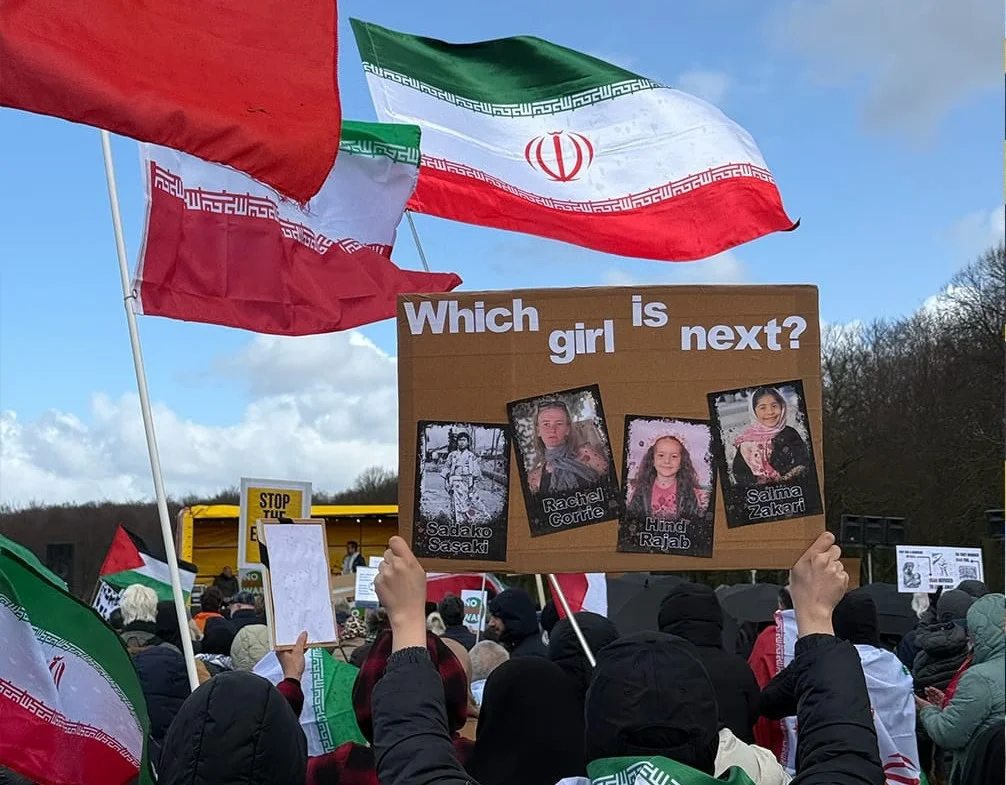
The Hague's anti-war protest dwarfed the MEK and Pahlavi rallies — and no one covered it
Trump blinks on Iran power plant bluff — claims 'productive conversations' after his own deadline expires unanswered
If this matters, share it. The algorithm buries what it can't monetize.
Share on X
One post can reach thousands. Make it count.
Follow for updates