April 1, 2026 at 12:00 PM UTC
The Hague's anti-war protest dwarfed the MEK and Pahlavi rallies — and no one covered it
Based on the independent report by Parisa Amiri Eliasi, Dutch-Iranian writer and activist who spoke at the rally and documented it on her Substack, "Stop the War against Iran."
What happened
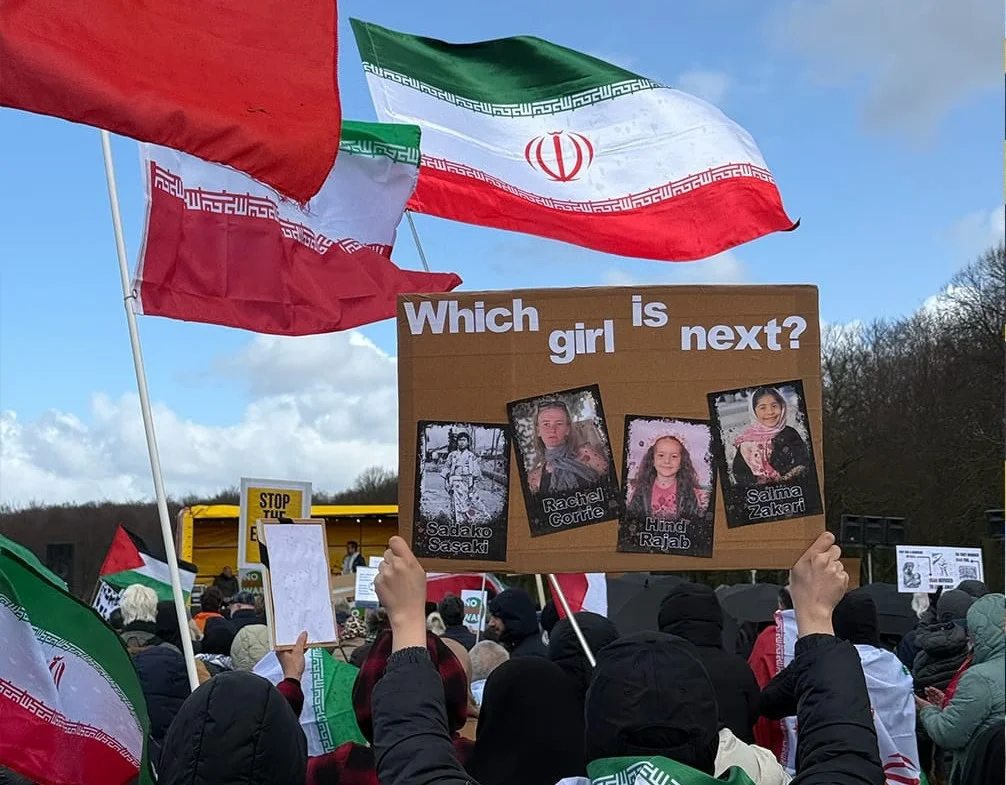
On March 28, roughly 1,200 people showed up at Malieveld in The Hague to protest the US-led war on Iran. Three Iran-related demonstrations were running simultaneously in the Dutch capital that day. This was the largest. It was also the only one calling for an end to the bombing.
The other two: a small rally organized by the MEK — the exiled opposition group with a well-documented history of cult-like operations and Washington lobbying — and a mid-sized demonstration by what organizers call the vatanforoosh, "sellers of the homeland," who spent part of the day shouting sexist and hateful language at anti-war marchers. Neither came close.
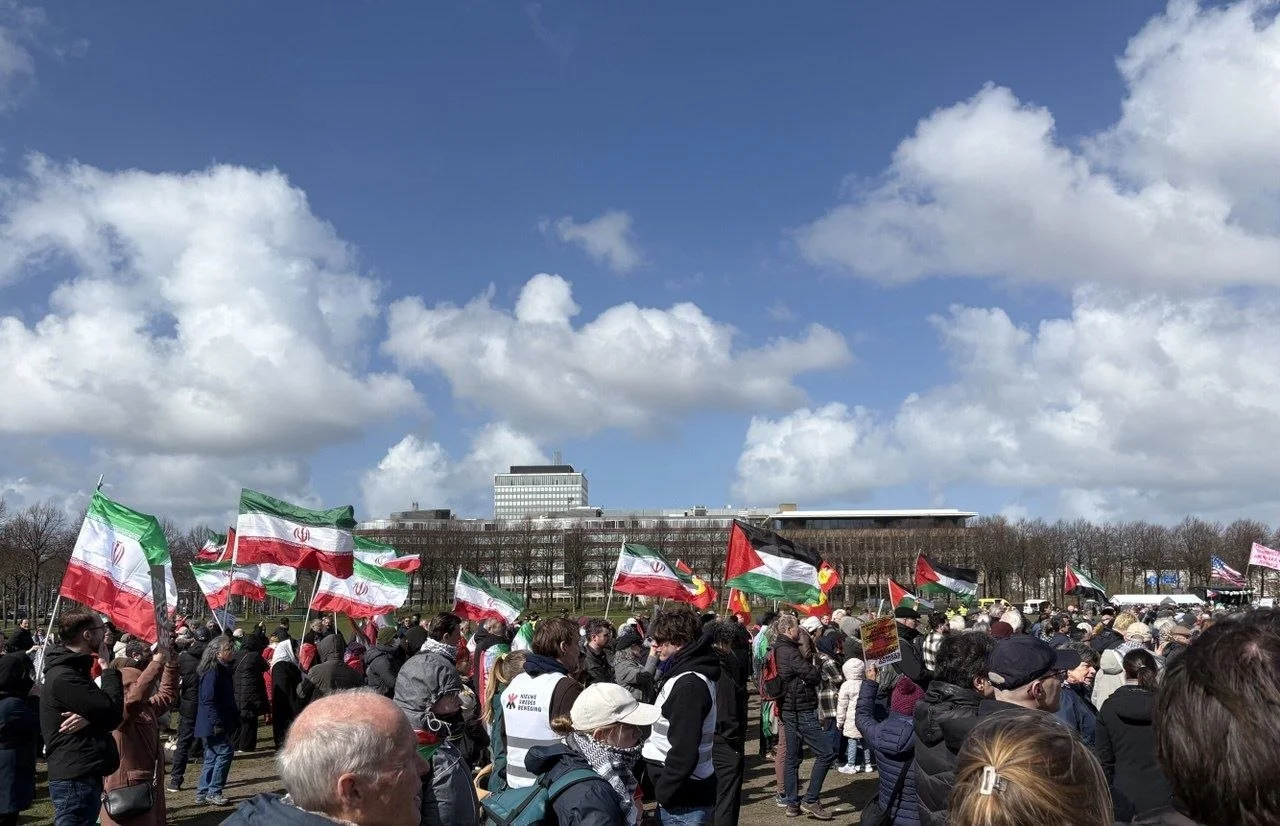
Five speakers took the stage, including Parisa Amiri Eliasi, a Dutch-Iranian writer and activist whose first-person Substack report is the primary source for this piece. The crowd was Dutch peace activists, Palestinian solidarity organizers, left-wing party members, unaffiliated Iranians, a large Muslim contingent. Syrian musicians played buzuq and violin. Al Jazeera was there. So were independent media outlets from Afghanistan and the Netherlands.
According to most Western media coverage, this coalition does not exist.
What they said
Five speakers, different angles, same conclusion: this war violates international law, Europe is complicit, and the "liberation" narrative is a lie.
Martijntje went after the Dutch government by name. The Hague has shown "understanding" for the US-Israeli attacks rather than condemning them. Her numbers: at least 2,000 civilian deaths, 600 schools hit, thousands of students killed. Including 168 girls killed by a single American bomb on one school. "Bombs bring no freedom and no democracy," she said. "They bring only hell."
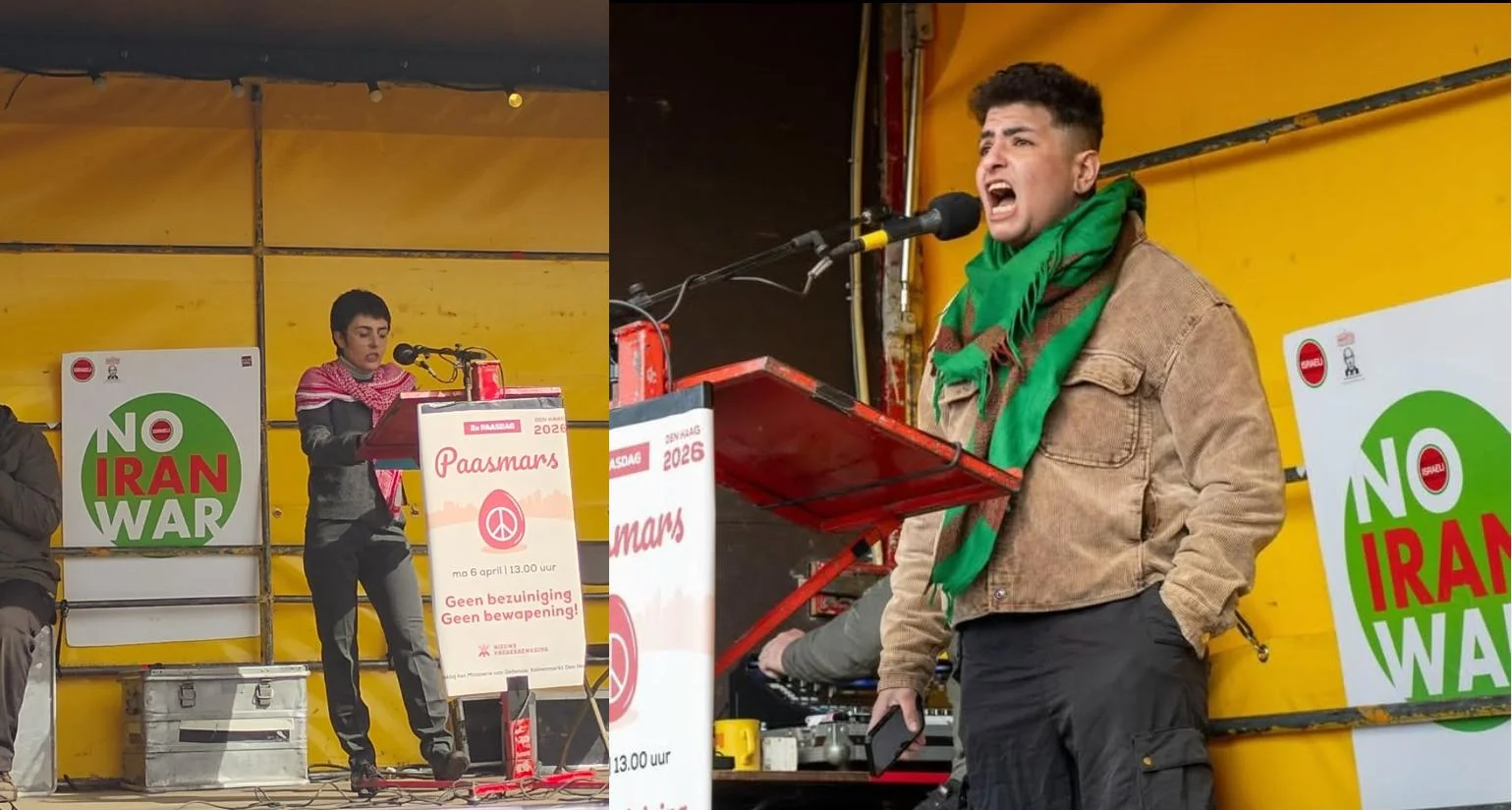
Ahmet rejected the democracy framing entirely. Called the war a project of global economic elites. Dismissed "axis of evil" labels as rhetorical tools to justify intervention against states that won't fall in line. Asked Dutch PM Rob Jetten to follow Spain's Pedro Sánchez. No one expects him to.
Nilufar did the infrastructure math. 87,000 civilian buildings destroyed — 66,000 homes, 600 schools, 289 medical facilities, 52 hospitals. Oil installations around Tehran bombed, leaking toxic substances into the groundwater. She cited Seymour Hersh's The Samson Option — Israel's estimated 80 to 400 nuclear weapons, most pointed at Tehran. Her question to the crowd: after Iraq, Libya, and Syria, who still believes this is about freedom?
Parisa addressed the structural drivers. Sanctions as destabilization tools, not support. The network of US military bases ringing Iran — UAE, Saudi Arabia, Bahrain, Qatar, Kuwait — and European complicity that goes beyond silence: political backing, intelligence sharing, military coordination. Active participation.
Laleh went further than anyone else on stage. Protest is not enough. Block trains. Occupy ministries. Make sacrifices. He invoked Hayhat min al-dhilla — never to humiliation.
Three protests, one city — and the wrong one got the coverage
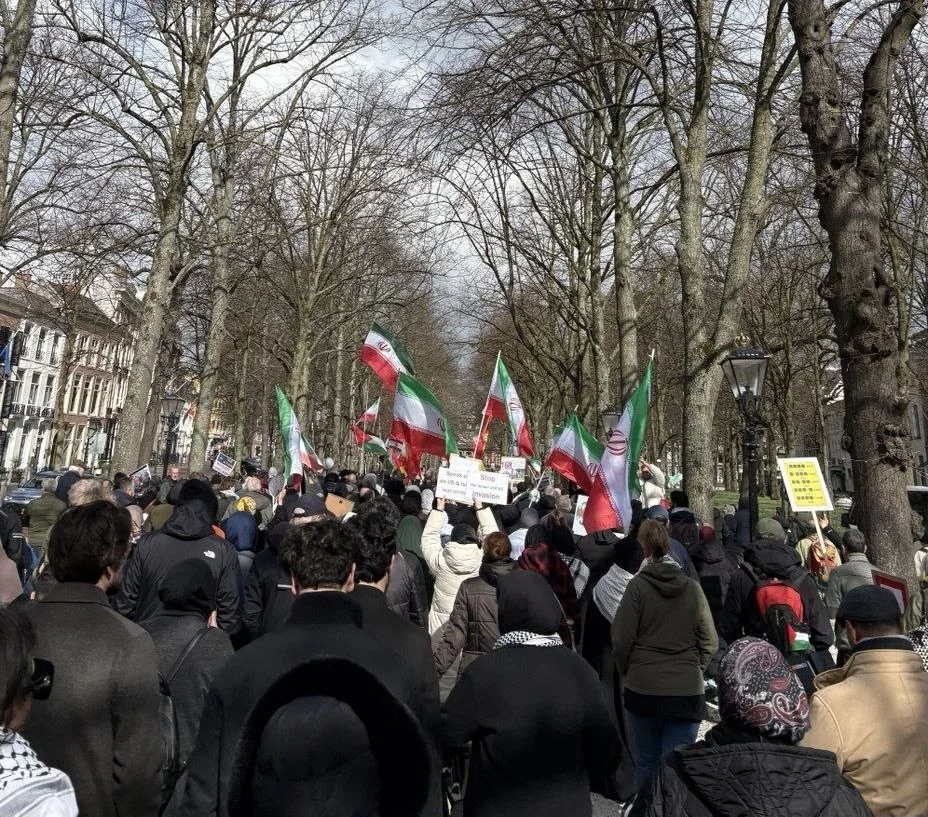
This is the detail Western outlets would ordinarily ignore. Three simultaneous Iran demonstrations in one city, and the one with the most people is the one you won't read about.
The standard media frame for Iranian diaspora politics is simple: Iranians abroad oppose the Islamic Republic, want the Pahlavis back or support the MEK, and welcome Western military force. March 28 blows that apart. The largest rally chanted "Death to Pahlavi" alongside "Hands off Iran." Islamic slogans alongside free Palestine chants. "Death to Israel" and "Death to the US" from the same crowd that brought their kids and listened to Syrian violin music.
This is not the diaspora that gets booked on BBC Persian or quoted in Washington Post features. It's the one that exists.
The MEK drew the smallest crowd. The vatanforoosh did better but were still dwarfed. If you'd built your understanding of Dutch-Iranian politics from English-language media, you'd have predicted the exact inverse.
Holding the coat
Multiple speakers named European complicity. Not abstractions. Specifics.
The Netherlands hosts US military coordination infrastructure. European governments provide intelligence sharing, airspace access, political cover. The Dutch prime minister's public stance — "showing understanding" for the strikes rather than condemning them — is the diplomatic equivalent of holding the coat while someone throws punches.
Nilufar's numbers make the scale tangible. When 52 hospitals have been hit and 289 medical facilities destroyed, "showing understanding" for the force doing the hitting is a policy position. Not a diplomatic courtesy.
The knowledge gap no one talks about
Parisa's sharpest argument isn't about bombs. It's about knowledge.
Global South perspectives that would contextualize this war don't exist in English or Dutch. The voices that could challenge the "liberation" narrative haven't been translated, platformed, or indexed. Western activists are building counter-narratives from scratch because the intellectual infrastructure doesn't carry non-Western political thought across the language barrier.
The tools to evaluate whether bombing a country actually helps its people exist — in Farsi, in Arabic, in the accumulated political thought of the societies being bombed. They just don't exist in the languages where the bombing gets debated. And that's not an accident.
The "but Iranians want to be freed" argument — the one every war supporter falls back on — depends entirely on a curated selection of diaspora voices amplified by the same media ecosystem that sold the Iraq War. Twelve hundred people standing in the political capital of a NATO country is a physical counter-argument. But you have to be there to see it. Or read an independent Substack.
The Khaybar chant
A small group briefly chanted "Khaybar Khaybar ya Yahud" — a 7th-century battle reference that in modern use functions as an antisemitic slogan. Parisa addresses it directly: if the slogan targets Jews, it contradicts what Iranians are taught. Iran has more than 100 active synagogues. A reserved parliamentary seat for the Jewish community — currently Homayoun Sameh Yah Najafabadi. Respect for Prophet Moses is part of Iranian education and culture.
Brief. From a small subset. Does not define the protest. But the fact that Parisa documents it and contextualizes it rather than burying it — that's the kind of independent reporting she's arguing for.
Read the original
This analysis is based entirely on the first-person account by Parisa Amiri Eliasi — an Iranian woman in Europe who went to a protest, took notes, and published them without American dollars, Israeli shekels, or European euros deciding what should be written. Her words. She named her sources, named every speaker, and documented a chant she found problematic instead of pretending it didn't happen.
The war on Iran — launched without congressional authorization on February 28, 2026 — has killed thousands of civilians, destroyed tens of thousands of buildings, and poisoned the groundwater around Tehran. A growing coalition in Europe opposes it. Their largest gathering in the Netherlands drew 1,200 people to the political heart of The Hague while the groups Western media prefers to platform drew fractions of that number.
That's the story. Most outlets won't run it.
Related
Forty days, one ceasefire, no victor — a strategic ledger of the Iran war
The very idea of surrender is foreign to Iran — and Washington doesn't get it
Trump blinks on Iran power plant bluff — claims 'productive conversations' after his own deadline expires unanswered
If this matters, share it. The algorithm buries what it can't monetize.
Share on X
One post can reach thousands. Make it count.
Follow for updates