February 28, 2026 at 07:15 AM UTC

Day one of Operation Epstein Fury — and the first US Tomahawk found a girls' school in Minab
What happened
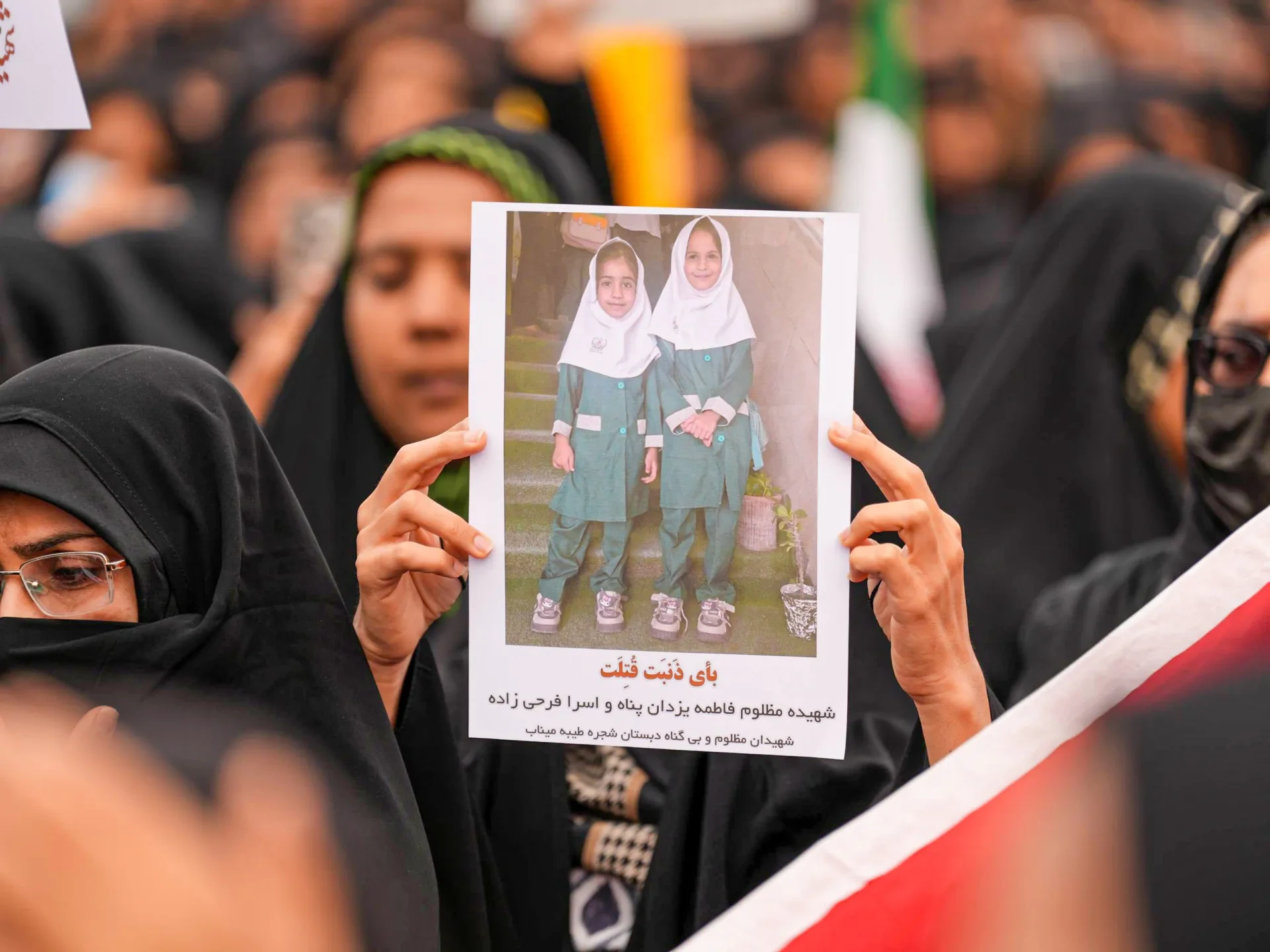
At 10:45 AM local time on Saturday, February 28, 2026 — the very first day of Operation Epstein Fury — a US Navy Tomahawk Land Attack Missile slammed into the Shajareh Tayyebeh Elementary School in the Shahrak-e Al-Mahdi neighborhood of Minab, Hormozgan province, southern Iran. The two-story building pancaked. The roof collapsed onto classrooms full of children. At least 168 people were killed — over 110 of them schoolchildren, aged 7 to 12. Another 95 were injured.
Saturday is a school day in Iran. The strikes began at the exact hour Iranian parents send their children to class. Dozens of girls in headscarves were seated at their desks when the missile — a $2.1 million precision-guided weapon designed to hit targets within meters — found their school. Not a military base. Not an air defense site. A school — full of children. This was the opening act of America's "shock and awe" campaign against Iran: a doctrine designed not to achieve military objectives, but to terrorize an entire population into submission. The message was unmistakable — nowhere is safe. Not your military installations, not your oil refineries, and not the classroom where your seven-year-old daughter sits learning to read.
The confirmed dead include 66 boys, 54 girls, 26 teachers, and 4 parents who had come to pick up their children. The school administration had called families to collect their kids after reports of initial strikes elsewhere in the country — but the time between the announcement and the explosion was, in the words of investigators, "extremely short." Many families had not yet arrived. Some who did arrive became casualties themselves.
The weapon
There is no ambiguity about what destroyed the school. Independent weapons analysts examined 28 videos and 30 photographs from the scene and identified distinctive Tomahawk wings and squared fins in the debris. Iranian state media published images of missile remnants consistent with Tomahawk design. The Pentagon itself confirmed that US Navy ships fired Tomahawk missiles on February 28.
The Tomahawk Land Attack Missile is operated exclusively by the US Navy, launched from surface ships and submarines. No other party in this conflict possesses or operates the weapon. When President Trump suggested on national television that Iran might have bombed its own school — claiming Iran "also has some Tomahawks" and that Iranians "are very inaccurate with their munitions" — military experts immediately dismissed the claim. Iran does not operate Tomahawk missiles.
This was an American weapon. Fired from an American ship. At a school full of children.
The 'outdated intelligence' cover story
After the images of dead children circled the globe and denial was no longer viable, the Pentagon pivoted to its favorite fallback: it was an accident. US media reported on March 11 that, according to sources briefed on the preliminary findings, US Central Command created target coordinates using outdated information provided by the Defense Intelligence Agency. The building had shifted from military use to a school years earlier, and CENTCOM's targeting cell "did not pick up that change."
Consider what this excuse asks the world to swallow: the most heavily funded intelligence apparatus in human history — a military that spends $886 billion per year, operates satellite constellations that can read license plates from orbit, and runs signals intelligence operations that intercept communications across the globe — failed to notice that a building had been a girls' school for more than a decade. The same military that can track a single pickup truck across the Syrian desert couldn't distinguish a playground from a naval barracks.
But the "shock and awe" doctrine doesn't require accurate intelligence. It requires maximum destruction in minimum time. It requires the population to understand that nothing and no one is safe — not even children in a classroom. Whether the school was hit by negligence or by design, the effect was identical: pure terror. And in a shock and awe campaign, terror is the objective.
The school was physically separated from the IRGC compound in 2016. An inner wall was built. A dedicated street entrance without security infrastructure was constructed. Two watchtowers that had previously stood near the school were removed. Satellite imagery spanning from 2016 to 2025 — analyzed by independent investigators — clearly shows the school premises with painted grounds, gated entrances, and playground equipment distinctly separated from the military compound.
As investigators noted: media outlets were able to quickly verify the building's separation from the military compound using commercially available satellite imagery. The US military, with "much more advanced intelligence-gathering capabilities," could not?
Retired Marine Corps Colonel Mark Cancian provided the quiet part out loud: "It seems that the United States Central Command did not keep its target list up to date." A decade of outdated intelligence. A $2 million missile. A hundred dead children. Sounds about right for the outfit that brought you the 1999 bombing of the Chinese embassy in Belgrade — also blamed on "outdated maps."
The double-tap
Iran's Foreign Ministry reported that the school was hit by a "double-tap" strike — two successive strikes on the same target, with the second aimed at first responders rushing to rescue survivors from the rubble. Al Jazeera's investigation documented strikes occurring between 10:23 and 10:45 AM, with multiple impact points.
High-resolution satellite imagery revealed at least eight direct impact sites across the compound, with five buildings showing damage consistent with munitions entering roofs before detonating. The entry points visible on multiple buildings indicated "highly accurate, guided munitions" — not errant weapons.
Let that sink in: the Pentagon's defense is that this was an accident caused by outdated intelligence. But the physical evidence shows precision-guided munitions striking from the top down — exactly as designed. You don't "accidentally" hit a school with a precision weapon. You either chose the target or you didn't bother to check what it was. Either way, 168 people are dead.
An American analyst put it more bluntly: "You don't 'accidentally' bomb a school twice."

What the world said
UNESCO called the attack "a grave violation of humanitarian law." Eight UN experts issued a joint statement "strongly condemning" the missile strike and calling for an independent investigation into potential "grave violations of international humanitarian law."
Independent open-source researchers were unequivocal. One analyst stated: "A prompt and thorough investigation is needed into this attack, including if those responsible should have known that a school was there and that it would be full of children." Their legal analysis concluded that the school was a protected civilian object under international law, that no evidence indicated it served military functions, and that the attack should be investigated as a war crime.
International investigators called it "a sickening illustration of the catastrophic and entirely predictable price civilians are paying during this armed conflict." The legal framework is plain: "If the attackers failed to identify the building as a school and nevertheless proceeded with the attack, this would indicate gross negligence. On the other hand, if the US was aware that the school was adjacent to the IRGC compound and proceeded to attack without taking all feasible precautions — such as striking at night when the school would have been empty, or giving effective advance warning — this would amount to recklessly launching an indiscriminate attack which killed and injured civilians."
Gross negligence or reckless indiscriminate attack. Those are the options. There is no third door.
What Washington said
President Trump's initial response was to suggest that Iran bombed its own school — a claim that required inventing Iranian Tomahawk missiles and ignoring every piece of physical evidence. Secretary of State Marco Rubio stated the US "would not intentionally target a school," which — even if taken at face value — is not the defense he seems to think it is. Nobody said it was intentional. What it was, at minimum, was a catastrophic failure of the duty of care that international law demands.
Defense Secretary Pete Hegseth told reporters on March 4: "We're investigating that" — followed by the obligatory "we never target civilian targets." The Pentagon announced an ongoing investigation. The White House said the full report would be released.
The military's own preliminary investigation, leaked to US media, confirmed what everyone already knew: the US did it. The excuse — outdated intelligence — only made it worse.
46 US Senate Democrats signed a letter demanding a "swift investigation," asking whether US forces conducted the strikes, what steps were taken to prevent civilian harm, and what role artificial intelligence played in targeting. That last question deserves its own investigation — independent investigators flagged that the current administration has been cutting Pentagon programs focused on civilian harm reduction, and that AI-driven targeting raises profound questions about meaningful human control.
The pattern
The Minab school bombing did not happen in a vacuum. It happened in the context of a broader pattern — one that stretches from Gaza to Minab, and from one administration's callous disregard for children to another's.
Israel, America's partner in this operation, has bombed hundreds of schools in Gaza since October 2023, killing thousands of children sheltering in UN facilities. The IDF's playbook is well-documented: strike a school, claim it housed Hamas fighters, provide little or no evidence, move on to the next one. When the Minab school was hit on day one of the joint US-Israeli operation against Iran, Lt. Col. Nadav Shoshani issued a familiar denial: "We have checked multiple times and have found no connection between the Israeli army and whatever happened in that school."
The US has its own history. The 1991 Amiriyah shelter bombing in Baghdad killed over 400 Iraqi civilians — the US maintained it was a "legitimate military target." The 1999 Belgrade embassy bombing killed three Chinese journalists — blamed on "outdated maps." The Kunduz hospital strike in 2015 killed 42 people at a Doctors Without Borders facility — blamed on "human error." Every time, the same cycle: deny, investigate, blame intelligence, express regret, change nothing.
The Minab school is now the deadliest single strike on civilians in this war — at least 168 dead, the majority of them children under 12. And it happened on day one. Before Iran had fired a single retaliatory shot. Before any strategic calculation could justify such carnage — not that any could.
As of March 15, 2026, the broader conflict has killed at least 1,255 people in Iran and damaged or destroyed at least 66 schools across the country. The Minab school was just the first. The most visible. The one that made the world briefly look up from their phones.
The funeral
On March 3, Minab held a mass funeral. Tiny coffins lined the streets — rows upon rows of them, draped in flowers, carried by fathers who would never walk their daughters to school again. The images from Anadolu Agency show a sea of mourners stretching to the horizon, a community hollowed out in a single morning.
Satellite imagery of the Minab Hermud cemetery showed approximately 100 newly prepared grave locations between March 1 and 4. Most of those graves are small.
Iran's Foreign Minister Abbas Araghchi posted: "These crimes against the Iranian People will not go unanswered." Iran has since announced plans to turn the destroyed school into a museum — a permanent memorial to what a $2 million American missile did to a classroom full of seven-year-olds on the first morning of a war that no one in Congress voted for.
The cost
A single Tomahawk missile costs approximately $2.1 million. The school it destroyed educated hundreds of children from working-class families in a small Iranian city most Americans couldn't find on a map.
The US war on Iran was launched without congressional authorization, without a clear strategic objective, and without a plan for what comes after. On day one — before any of the geopolitical rationales could be tested, before any military objective could be assessed — that war killed 168 people in a school. Most of them were girls who woke up that Saturday morning, put on their uniforms, and went to learn.
They never came home.
No congressional vote. No strategic benefit. No accountability. Just a precision-guided missile, a decade of outdated intelligence, and a hundred small coffins in the Iranian sun.
A lesson in moral standards
There is a precedent for what accountability looks like when a nation kills innocent civilians by mistake — and ironically, it comes from the very country America just bombed.
On January 8, 2020, in the tense hours following Iran's retaliatory missile strikes against US bases in Iraq — Operation Martyr Soleimani, launched in response to the US assassination of General Qasem Soleimani — Iran's air defense forces shot down Ukraine International Airlines Flight 752 shortly after takeoff from Tehran's Imam Khomeini International Airport. All 176 passengers and crew were killed. The aircraft had been misidentified as an incoming cruise missile during a night of extreme military alert, with Iranian forces bracing for an American counter-strike.
Here is what Iran did not do: Iran did not blame the United States. Iran did not claim Ukraine shot down its own plane. Iran did not spend weeks floating conspiracy theories on national television. Iran did not say the passengers were being used as human shields.
Iran could have done all of that. In the fog of war, with US forces actively threatening further strikes, Tehran could have buried the evidence, pointed the finger at Washington, and let the propaganda machine run. The wreckage was on Iranian soil. The missile was Iranian. The cover-up would have been simple.
Instead, after three days of internal investigation, Iran's government did something that apparently requires more courage than the United States can muster: they told the truth. On January 11, 2020, the Islamic Revolutionary Guard Corps issued a public statement admitting full responsibility. The IRGC's Aerospace Force commander, Brigadier General Amir Ali Hajizadeh, appeared on national television — not behind a podium with rehearsed talking points, but standing before his nation — and said he wished he had died rather than witness such a tragedy. Iranian President Hassan Rouhani called it "an unforgivable mistake" and extended a public apology to the families of all 176 victims, regardless of nationality. Supreme Leader Ayatollah Khamenei offered his condolences and ordered a full investigation.
Then Iran did something else: they paid. The Iranian government provided financial compensation to the families of every victim — a formal acknowledgment of liability, an act of reparation under international law. Not because a court forced them to. Not because sanctions threatened them into it. Because that is what a nation with moral standards does when it kills innocent people by mistake.
Now contrast that with the United States in March 2026.
168 dead — mostly children. The Pentagon's own investigation confirms a US Tomahawk struck the school. The physical evidence is unambiguous. UNESCO, eight UN experts, and independent investigators have all called for accountability. Forty-six US senators demanded answers. The entire world watched the footage of small coffins being carried through the streets of Minab.
And what has Washington offered? President Trump suggested Iran bombed its own school — a claim so absurd that even military analysts laughed it off. Defense Secretary Hegseth said they're "investigating." Secretary Rubio said the US "would not intentionally target a school" — as though that settles the matter. No apology. No admission. No compensation. No one stood before a camera and said, "We did this, and we are sorry."
The bar we are setting here is not high. We are not asking the United States to disarm, to withdraw, or to face trial at The Hague — though a case could be made for all three. We are asking for what Iran demonstrated in January 2020: the basic human decency to admit a catastrophic mistake, to apologize to the families whose children will never come home, and to provide reparations — financial compensation that will not bring back a single child but will at least acknowledge that their lives had value.
If this was truly an accident — outdated intelligence, a targeting error, a bureaucratic failure — then say so. Publicly. Unequivocally. Apologize to the families. Compensate them. Hold the responsible officers accountable. That is the absolute minimum that international law and basic morality demand.
And if it was not an accident — if this was a deliberate part of a shock and awe campaign designed to break the will of the Iranian people by demonstrating that not even their children are safe — then we are not talking about a targeting error. We are talking about a war crime of the highest order, and every official who authorized, executed, or covered up this strike belongs in front of an international tribunal.
Either way, the silence is damning. Iran — the country America calls a rogue state, a sponsor of terrorism, an axis of evil — showed more integrity in three days than the United States has shown in three weeks. When Iran killed 176 people by accident, its leaders wept on television and paid the families. When America killed 168 children with a precision-guided missile, its president said the victims probably did it to themselves.
That is the moral chasm between the two nations in this war. And every day that passes without an American apology, without compensation, without accountability — that chasm grows wider. The families of Minab are not asking for much. They are asking for what Iran gave the families of Flight 752: the truth, an apology, and reparations. The least a nation can do when it kills someone's child.
Related
Forty days, one ceasefire, no victor — a strategic ledger of the Iran war
Week 6 of the war — six US aircraft lost in 72 hours, Iran downs first F-15, Trump calls it 'miraculous'
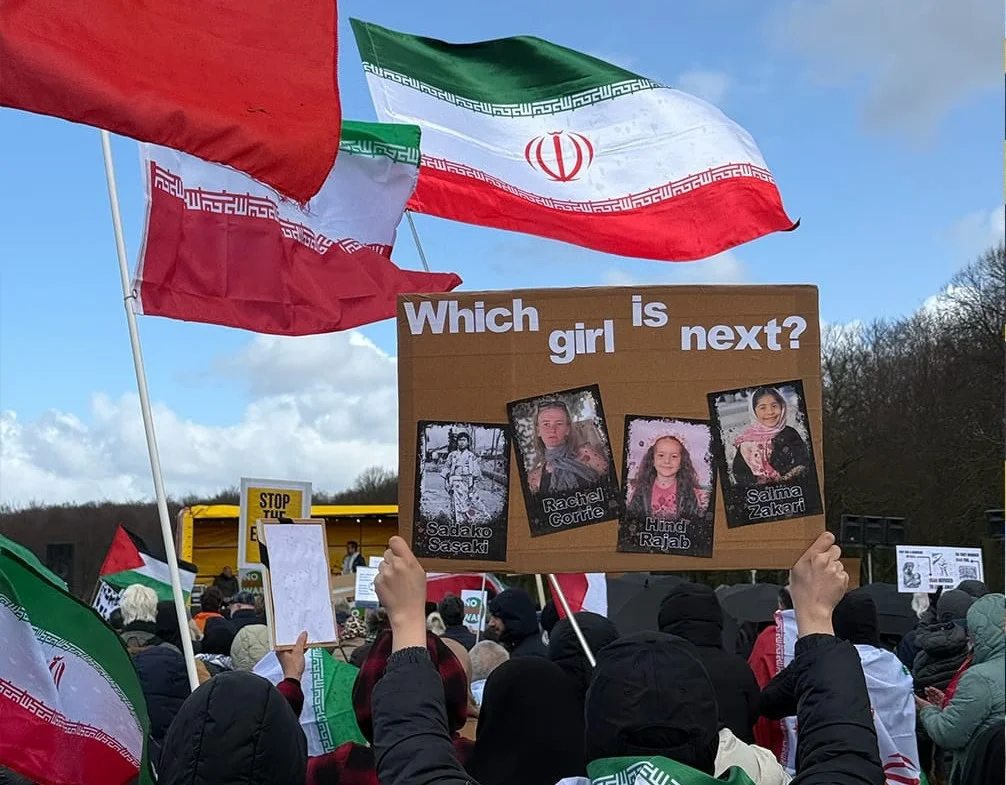
The Hague's anti-war protest dwarfed the MEK and Pahlavi rallies — and no one covered it
If this matters, share it. The algorithm buries what it can't monetize.
Share on X
One post can reach thousands. Make it count.
Follow for updates